
Georgia Doesn't Collect Your Records — Until Everyone Else Demands Them
You filed your Declaration of Intent. You are teaching the five core subjects. Georgia law requires 180 days of instruction at 4.5 hours per day, but it does not require an attendance log. It does require you to retain annual progress reports and standardized-test records at home. Those records are not routinely filed with the GaDOE; school-sponsored extracurricular participation under the Dexter Mosely Act requires written notice of intended participation, the most recent annual progress report, and written instructor verification to the resident school's principal and the superintendent of the resident school system at least 30 calendar days before the first school day of the semester in which the student will enroll in a qualifying course.
Then a DFCS caseworker arrives and asks for three years of progress reports. Your tenth-grader wants to dual-enroll through Georgia's Dual Enrollment Program and the coordinator asks for a transcript you never built. Your twelfth-grader applies for the HOPE Scholarship through GAfutures and discovers that an unaccredited home study graduate uses a score-based upfront path: at least a 1160 SAT or 24 ACT composite before home study completion. For Zell Miller, the upfront minimum is 1340 SAT or 29 ACT composite, and nobody told her until April of senior year.
Georgia's low-burden filing system is the trap. Colleges, scholarship evaluations, DFCS assessments, and school transitions can still call for documentation on short notice. And if you cannot produce comprehensive, organized documentation when asked, the consequences are immediate.
The Georgia Portfolio & Assessment Templates is a complete documentation system built around O.C.G.A. § 20-2-690(c), Georgia's core home study statute. It gives you the templates, tracking systems, and pre-built language you need to stay organized in 15 minutes a week, and to be prepared for the high-stakes moments that arrive without warning.
— less than a single month of an umbrella school that charges $300 a year to hold your records in a filing cabinet.
What's Inside
Compliance Foundation
- 180-Day / 4.5-Hour Attendance Tracker — A monthly calendar system mapped to Georgia's exact statutory requirement. Designed so field trips, co-op days, PE, music lessons, and project work all count naturally toward the 4.5-hour total — because the law says they do, and your tracker should reflect that without making you log every minute.
- Annual Progress Report Templates — Three format options (narrative, skills checklist, report card) with pre-built language covering all five mandated subjects. Written to satisfy the statutory requirement without volunteering more information than the law demands — because a progress report that over-reports is a liability, not a strength.
- DOI Filing & Renewal Guide — Step-by-step walkthrough of the GaDOE portal, the 36-character confirmation code, the September 1 annual deadline, and the public-school referral deadlines: 30 consecutive days when required withdrawal or enrollment notice is missing or a withdrawn student's DOI is not filed; 45 days when a student age 16 or older stops attending without the required conference.
Five-Subject Portfolio System
- Work Sample Filing System — Organized by Georgia's five legally required subjects (reading, language arts, mathematics, social studies, science) with grade-banded guidelines showing how many samples to keep per subject and what types of evidence work for different homeschool styles.
- Standardized Testing Guide — Which tests qualify (CAT, Stanford 10, ITBS, P.A.S.S., SAT, ACT), where to find Georgia test administrators, how to schedule around the grade 3/6/9/12 triennial cycle, and what to do with the score reports afterward.
High School & Scholarships
- USG Admissions Transcript Builder — A transcript template organized around the University System of Georgia's 17-unit Required High School Curriculum, with fields for courses, credits, grades, grading scale, and GPA. The tools help organize the curriculum details and final transcript used in USG admissions and the separate GAfutures scholarship evaluation.
- HOPE & Zell Miller Scholarship Eligibility Tracker — The academic paths for unaccredited home study graduates: upfront scores of 1160 SAT or 24 ACT composite for HOPE, and 1340 SAT or 29 ACT composite for Zell Miller; retroactive HOPE after 30 semester or 45 quarter hours and a 3.0 postsecondary calculated HOPE GPA; retroactive Zell Miller after the same hours, a 3.3 postsecondary calculated HOPE GPA, and a 1200 SAT or 26 ACT composite earned before home study completion. The Academic Rigor Course List is shown separately from these unaccredited scholarship paths.
- Dual Enrollment Tracker (formerly Move On When Ready) — For Dual Enrollment participants: what documentation the college coordinator needs, how college credits map to your transcript, and how to track Georgia Virtual School (GAVS) courses alongside traditional coursework.
Who This Is For
The First-Year Parent
You filed the DOI and now you are staring at a blank binder wondering what a progress report is supposed to look like. Georgia law says you must write one every year covering all five core subjects — GHEA lists the subjects and suggests checklist, narrative, and chart formats, but you still have to build a report that fits your records. Every blog post you find says something different. This guide gives you three ready-to-use formats with filled examples so you can pick one and be done in an evening.
The HOPE Strategist
Your student is in ninth or tenth grade and you are already thinking about the HOPE Scholarship. You know that upfront HOPE and Zell Miller eligibility for unaccredited home study graduates is based on qualifying test scores, not a parent-assigned GPA — but GAfutures lays out separate score and postsecondary-hour paths, and nobody has given you a clear, year-by-year tracking system. The transcript builder and scholarship tracker in this guide are built around those distinct processes, not adapted from a generic template.
The Military Family
You are at Fort Benning, Fort Stewart, Robins AFB, or Kings Bay, and you know a PCS is coming. South Carolina, North Carolina, and Alabama all have different homeschool requirements, and the receiving school district will ask for documentation from Georgia. The special situations chapter covers what records to organize before you move and distinguishes MIC3's public-school protections from each state's homeschool requirements.
After You Have This System
- You will know which progress reports and test records O.C.G.A. § 20-2-690(c) requires you to retain — and which supporting records a tracker can help you organize
- You will have a progress report template with pre-built language for all five subjects that satisfies the statute without over-reporting
- Your attendance tracker will map directly to the 180-day/4.5-hour requirement without requiring minute-by-minute logging
- If a DFCS caseworker or superintendent requests records, you will have three years of organized documentation ready to produce
- If your high schooler applies to a Georgia university, you will have a transcript formatted for the system that processes it — not a generic spreadsheet that gets flagged
- If your student qualifies for HOPE or Zell Miller, you will have the documentation trail that proves it from year one — not a panicked reconstruction in April
Why Not Just Use GHEA's Free Resources?
GHEA is excellent at explaining what the law requires. They will tell you that you need a progress report, that it must cover five subjects, and that you must retain it for three years. What they do not provide is the template. They will tell you that a high school transcript should be "a one-page summary of your student's coursework, grades, and credits earned" — but they will not hand you a fillable document formatted for the GAfutures portal.
The GaDOE portal handles the Declaration of Intent, and Georgia law also assigns the department an enforcement role for compulsory attendance in home study programs. The DOI form itself does not include a progress-report template, and the statute does not prescribe a report format. The $2 planners on Etsy are beautifully designed and legally irrelevant — they do not reference Georgia's five required subjects, they do not align with the 180-day/4.5-hour statute, and they will not help your student when the GSFC evaluates an unaccredited transcript.
This guide fills the gap between "here is what the law says" and "here is exactly how to do it, in a format that holds up when it matters."
Instant Digital Download — 11 PDFs
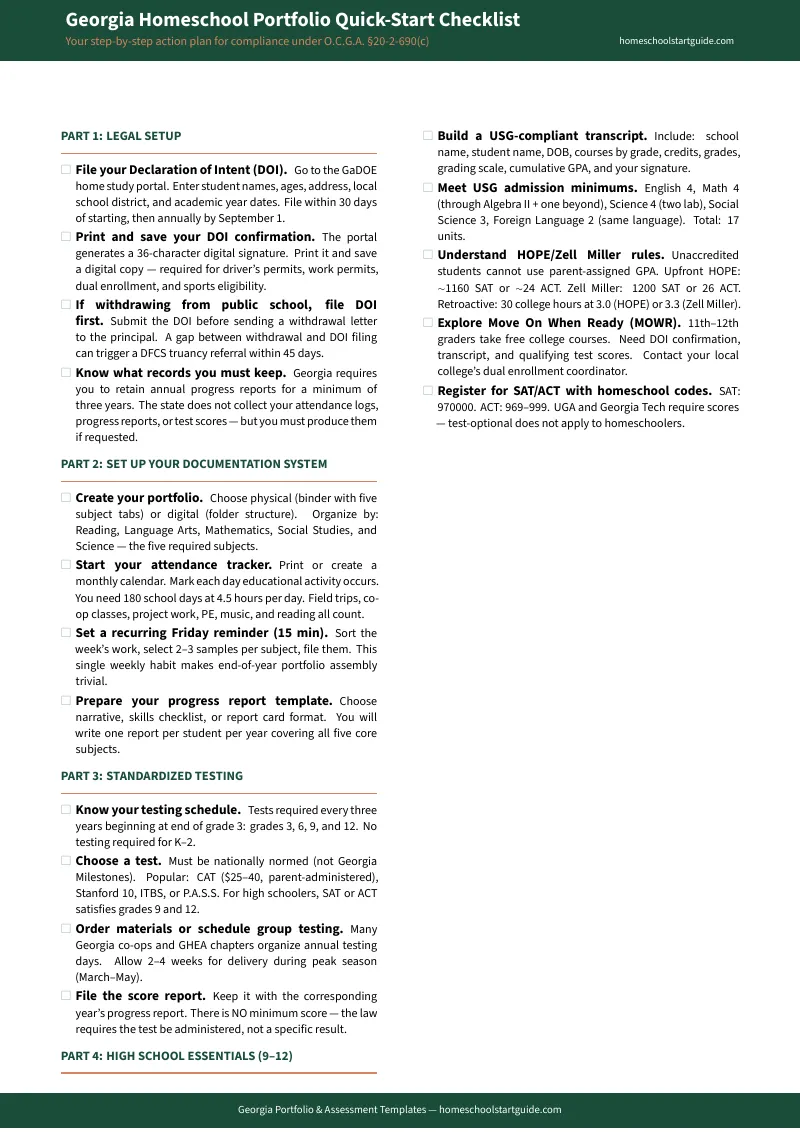
The complete guide (63 pages), a two-page Quick-Start Checklist, plus 9 standalone printable tools: attendance tracker, progress report templates (3 formats), standardized testing reference, grade-banded portfolio frameworks, USG admissions transcript template, HOPE & Zell Miller scholarship tracker, Dual Enrollment tracker, military PCS checklist, and annual compliance calendar. Download immediately after purchase. No shipping, no waiting, no account required.
Frequently Asked Questions
What if the rules change after I buy?
We update the guide when the rules change. Email us any time, even years later, and we'll send you the current edition free.