The Complete Compliance System for New York Homeschool Documentation
Every New York homeschool parent lives with the same background anxiety: Is my IHIP detailed enough? Will the district accept my quarterly report? Am I logging hours correctly? What happens if I miss a deadline?
Commissioner's Regulation 100.10 gives New York one of the heaviest documentation burdens in the country. You file a Letter of Intent by July 1. You submit an IHIP by August 15 or within four weeks of receiving district materials, whichever is later; NYC Public Schools' current instructions say to submit it within 28 days of starting. For a full school year, you submit four Quarterly Reports on evenly spaced dates set in your IHIP; mid-year programs submit reports in proportion to the period of home instruction. You submit an Annual Assessment with the fourth Quarterly Report by June 30. These requirements recur each school year.
Miss a deadline, and the district places your program on probation. Word an IHIP poorly, and it gets rejected. Over-share on a quarterly report, and you invite scrutiny you never needed. Get to high school and discover that New York does not issue diplomas to homeschoolers — and suddenly SUNY admissions looks like a wall.
So you download an outdated Word document from a Facebook group. You use the district's proprietary form that asks for far more than the law requires. You could pay New York Homeschool Consultant $150 to write an IHIP because you cannot figure out the formatting. You spend entire weekends writing quarterly reports that could take fifteen minutes with the right template.
The New York Portfolio & Assessment Templates is a Complete Compliance System — not a collection of blank forms, but an integrated documentation workflow that covers every piece of paperwork 100.10 requires. IHIP templates by grade band (1–6, 7–8, 9–12), quarterly report frameworks with district-safe language, annual assessment preparation for both testing and narrative years, and a high school transcript builder organized around New York's 22-credit diploma framework. Built for both NYC DOE families and upstate/suburban district filers.
— less than the $50 30-minute phone consultation listed by New York Homeschool Consultant, and you own the system permanently.
What's Inside
IHIP Construction by Grade Band
- Three Grade-Band IHIP Templates — because the required subjects change at every level and a generic template invites rejections. Separate fill-in-the-blank IHIPs for Grades 1–6 (12 subjects, 900 hours), Grades 7–8 (adds Practical Arts and Library Skills — 990 hours), and Grades 9–12 (990 hours, with 22-credit transcript mapping). Each template uses broad phrasing designed to include the required subject and plan details: "Instruction will include, but is not limited to..."
- Required Subject Master Lists — because the most common IHIP rejection is a missing subject. Complete checklists for each grade band so you never accidentally omit Patriotism and Citizenship, Highway Safety, or Fire and Arson Prevention and Safety (Grades K–12), or the 0.5 credit each required for Participation in Government and Economics (Grades 9–12).
Quarterly Reports That Write Themselves
- District-Safe Report Templates — because the current NYC DOE form asks for total instructional hours for the quarter, materials covered in each subject, and a grade or written evaluation for each subject. Templates with pre-written neutral language that satisfies the regulation without over-reporting. Write summaries, not inventories: "Completed units on fractions and measurement" — not a list of every worksheet your child touched.
- Hours Tracking System — because Grades 1–6 should average approximately 225 hours per quarter and Grades 7–12 should average approximately 247.5. Weekly logging templates tally annual totals so you are not doing panicked arithmetic the night before a quarterly deadline.
- The Friday 15-Minute Habit — because the families who never stress about quarterly reports are the ones who sort work samples and update their hours log once a week. The guide builds this into your routine so reports assemble themselves over the quarter instead of consuming an entire weekend four times a year.
Annual Assessment Preparation
- Assessment Type Decision Matrix — because the rules change by grade and most free resources get this wrong. Grades 1–3: standardized test or written narrative each year. Grades 4–8: standardized test at least every other year, with written narratives in alternating years. Grades 9–12: standardized test every year. A clear visual chart so you know exactly what your child needs this year.
- Written Narrative Templates — because in the years you can use a narrative instead of a test, having a professional template saves you $50–$150 in evaluator fees. Fill-in-the-blank assessment narratives use district-safe language to support the evaluator's certification of "adequate academic progress."
- Standardized Test Logistics Guide — because parents waste weeks figuring out which test to order, where to order it, and what the passing threshold is. Current options include the CAT Survey for Grades 4–12 ($37 through Seton) and the P.A.S.S. for Grades 3–8 ($42 through Hewitt, untimed and designed for homeschoolers). The guide covers ordering timelines, administration rules, and what the 33rd-percentile threshold actually means.
Portfolio Architecture by Grade Level
- Grade-Level Portfolio Frameworks — because a first grader's portfolio looks nothing like a tenth grader's. Separate systems for K–3 (skills emergence, minimal written output), 4–6 (subject deepening, work samples), 7–8 (analytical development, longer-form writing), and 9–12 (transcript-ready documentation with course descriptions). Each framework specifies how many samples per subject per quarter and what "representative work" actually means.
- Non-Traditional Learning Documentation — because the most common question on every NY homeschool forum is "how do I document unschooling for the district?" A translation guide that maps interest-led learning, field trips, museum visits, and project-based work into the state's required subject categories using compliant language.
High School Transcript & College Admissions
- 22-Credit Transcript Builder — because New York homeschoolers do not receive a state diploma. A fillable template organizes high-school coursework around the state's 22-credit diploma framework: 4 English, 4 Social Studies (including 0.5 credit each in Participation in Government and Economics), 3 Math, 3 Science (with lab documentation), 1 World Language, 1 Art/Music, 0.5 Health, 2 PE, and 3.5 Electives. It includes a GPA calculator and course description templates for college applications. Transcript services charge $60–$120; this template lets you produce one in an afternoon.
- SUNY/CUNY Admissions Pathways — CUNY requires New York State homeschool applicants to submit a transcript and superintendent's letter; if the letter is unavailable, CUNY requires an HSE diploma. SUNY campuses set their own admission requirements and may admit homeschooled students without proof of a diploma or equivalent. The guide covers these documents and college-credit options so you can start preparing in 10th grade, not scramble in 12th.
- Dual Enrollment & Regents Exam Guide — because community-college courses can provide college credit, but the receiving college decides whether credits transfer. Regents exams can add a state assessment result to a homeschool record, but access is through a public or registered nonpublic school and is subject to the principal's discretion. The guide covers eligibility, documentation requirements, and how to approach districts about homeschooler participation.
NYC DOE vs. Upstate Districts
- NYC-Specific Procedures — because the DOE's Office of Homeschooling has its own forms, its own timeline, and its own bureaucratic personality. The guide covers what is different about NYC filings — and what is not — so you use the correct process for your location.
- District Pushback Playbook — because some districts demand daily lesson plans, in-person meetings, or immunization records that 100.10 does not authorize. Scripts and letter templates for responding to overreach politely and effectively, citing the specific regulatory provisions that limit the district's authority.
Who This Is For
The New Homeschooler Overwhelmed by the IHIP
You just filed your Letter of Intent — or you are about to — and now you are staring at a blank IHIP wondering how to describe "curriculum" for 12 subjects when your six-year-old learns through play, nature walks, and library books. The IHIP templates give you fill-in-the-blank frameworks with language broad enough to protect your flexibility and organized around the required subjects and plan details.
The Parent Dreading the Next Quarterly Report
It is November and the first quarterly is due. You have work samples scattered across the dining table, a half-filled spreadsheet, and no idea whether you have hit 225 hours. The documentation system turns this from a weekend-consuming crisis into a 15-minute task — because you have been logging weekly all quarter.
The Mid-Year Withdrawer in Panic Mode
Something happened at school — bullying, unmet IEP needs, school refusal — and you pulled your child mid-semester. The LOI is due within 14 days of starting home instruction. The statewide IHIP window is four weeks after receiving district materials; NYC's instructions say to submit within 28 days of starting. You need to prorate the hour requirement and start documenting immediately. The guide walks you through the timeline and gives you templates to start using today.
The High School Parent Facing College Applications
Your teenager is approaching 11th grade and you are realizing that New York does not give homeschoolers a state diploma. CUNY requires New York State homeschool applicants to submit a transcript and superintendent's letter; if the letter is unavailable, CUNY requires an HSE diploma. SUNY campuses set their own admissions requirements and may admit homeschooled students without proof of a diploma or equivalent. Cornell says a homeschool transcript should list courses by grade level and performance indicators; it encourages detailed documentation of curriculum, assessment tools, learning experiences, and materials used. For state aid, HESC recognizes a superintendent's substantial-equivalency letter, a New York HSE diploma, or an approved Ability-to-Benefit test. The transcript builder and admissions guide help you organize these records before deadlines force a four-year reconstruction.
Why Free Tools Fall Short
NYSED and the NYC DOE provide the raw regulatory text and basic PDF forms. The forms are bureaucratic and intimidating — the current NYC DOE quarterly report asks for total instructional hours, materials covered in each subject, and a grade or written evaluation for each subject, but provides little guidance on what to write. They provide zero high school transcript templates. You are entirely on your own for the hardest parts.
NYHEN (New York Home Educators Network) offers free IHIP models and legal interpretation, but the website is chronically outdated, the templates are archaic plain-text documents with no modern formatting, and there is no integrated system that connects the IHIP to quarterly reports to assessments.
LEAH (Loving Education At Home) publishes a comprehensive free regulatory manual — genuinely useful. But LEAH is a Christian organization, and some chapters require members to sign a statement of faith. Their sample IHIPs list specific curriculum materials, including Reading Pathway, Understanding Writing, and Math-U-See. If you use different materials or an approach not reflected in the examples, adapt them to your own plan.
Etsy templates include examples like a $6 quarterly-report form and a $16.99 IHIP-and-quarterly bundle. Buying separate products from different sellers can leave families with tools that don't connect to each other, and many listings do not include the high-school transcript or annual-assessment narrative support.
Homeschool consultants — for example, New York Homeschool Consultant lists a $150 IHIP-only service and a $950 full-year package for 2026–27. Professional evaluators charge $50–$150 per annual assessment. HSLDA membership costs $150 per year. These are excellent services for families who need them, but if your primary pain point is formatting and language — knowing what to write and how to phrase it — you are paying professional fees for an administrative problem that the right templates solve permanently.
The Complete Compliance System fills these gaps in one place — built around what 100.10 actually requires, organized by the annual cycle you actually follow, and written in the district-safe language that keeps your submissions clean.
After You Have This System
- You will know exactly which documents 100.10 requires — and which common district requests (daily lesson plans, specific curriculum details, in-person meetings) you can politely decline
- You will have a 15-minute weekly habit for logging hours and sorting work samples that keeps you compliant year-round without quarterly panic
- You will have IHIP templates organized around the required subjects and plan details, with broad language that preserves flexibility
- You will know how the 80% coverage rule applies to quarterly reports and how to prepare an IHIP that reflects your teaching plan
- If you are in a narrative assessment year, you can use the professional template to prepare the evaluation when your grade and district rules allow it, instead of paying $50–$150 for an evaluator
- If your high schooler needs a transcript for college applications, you will have a professional-format document with a GPA calculator and 22-credit framework — not a last-minute reconstruction from memory
Instant Digital Download
Your download includes 10 print-ready PDFs:
- The Complete Guide (16 chapters, 70+ pages) — the full documentation system from LOI through college admissions
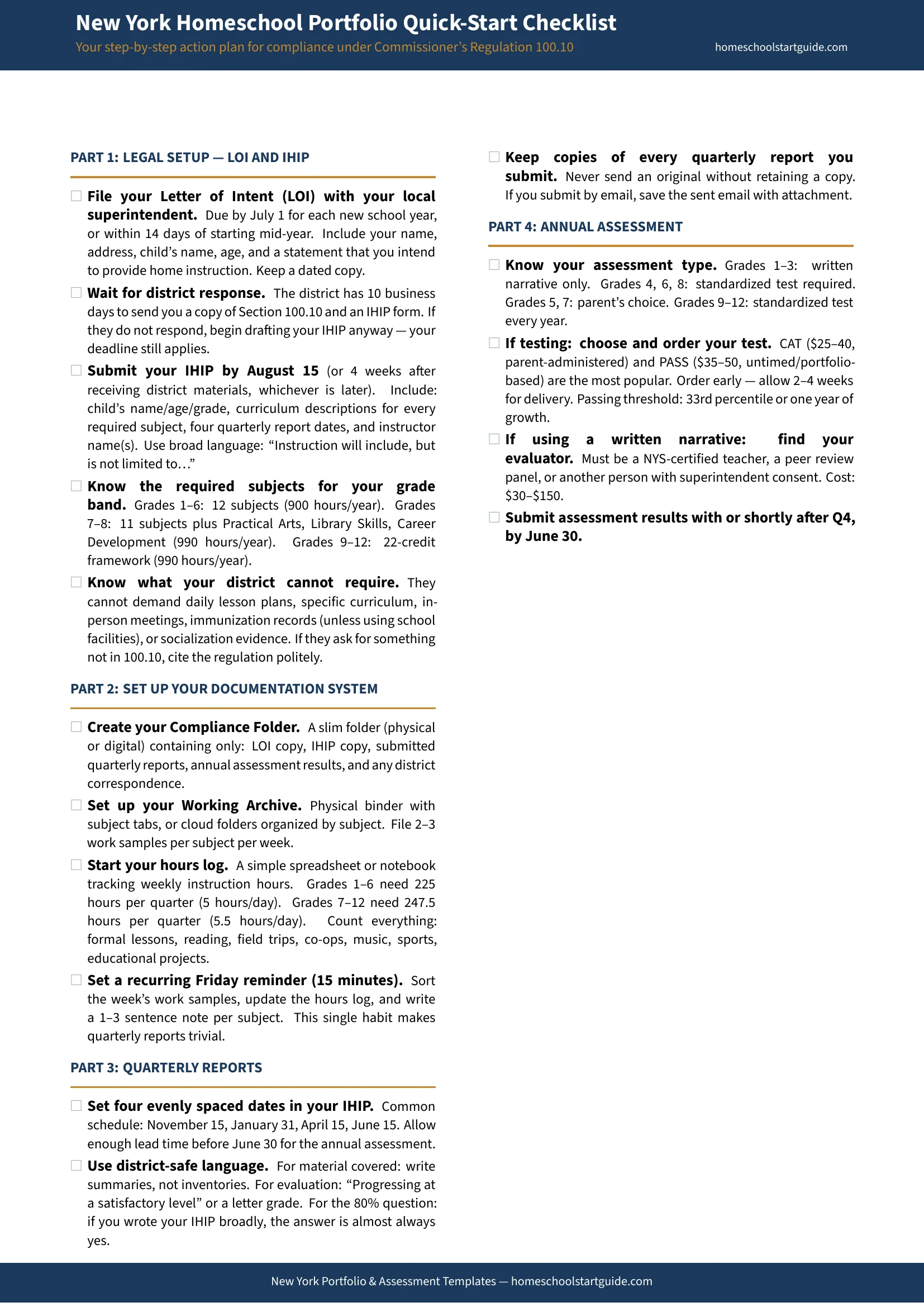
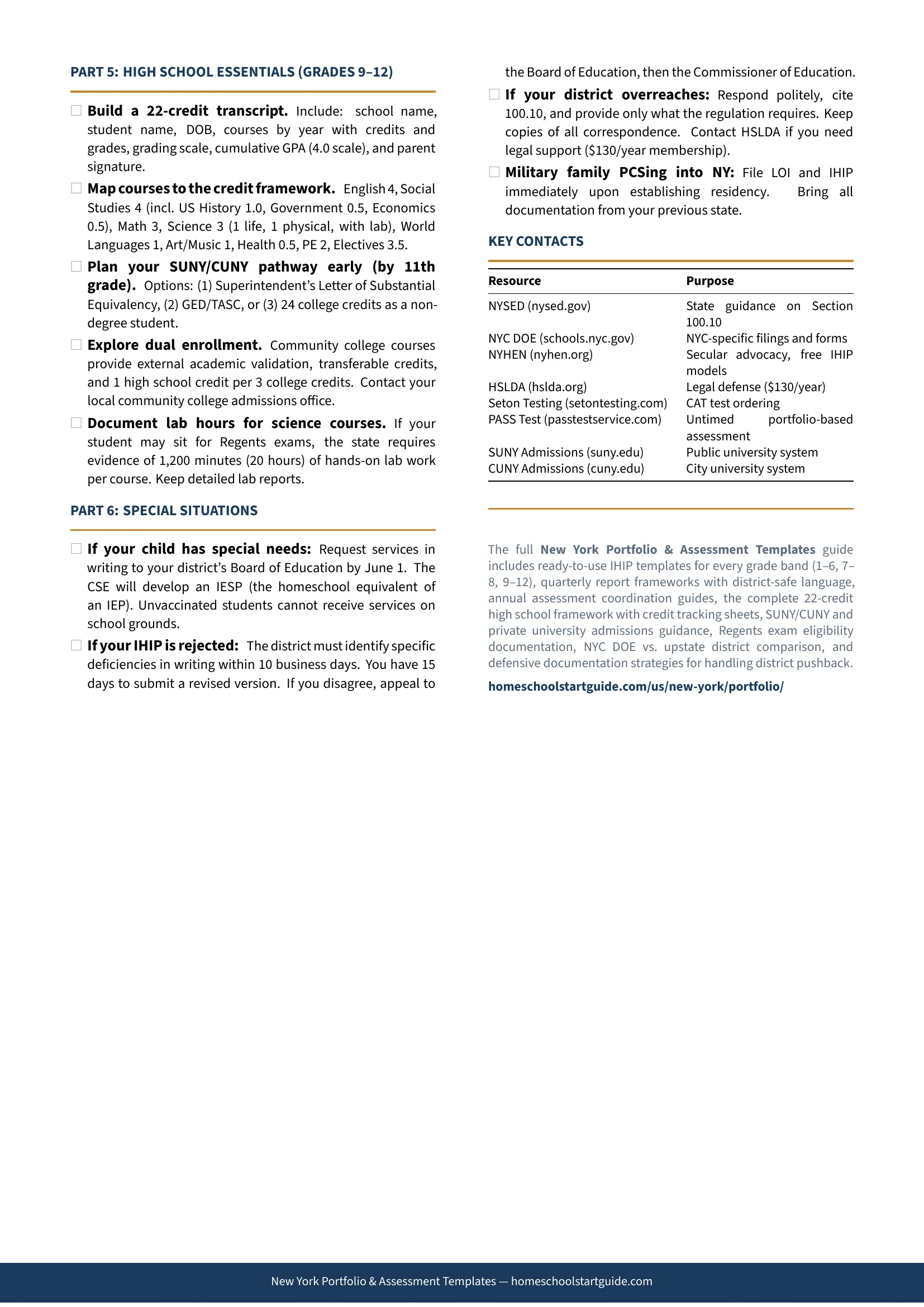
- Quick-Start Checklist — step-by-step compliance roadmap
- IHIP Templates — fill-in-the-blank plans for Grades 1–6, 7–8, and 9–12
- Quarterly Report Template — subject grid, hours section, and 80% coverage statement
- Hours Tracking Log — weekly logging sheet with quarterly totals
- Assessment Decision Matrix — grade-by-grade assessment requirements and approved tests
- Narrative Assessment Template — fill-in evaluation form for narrative years
- 22-Credit Transcript Builder — 4-year transcript with GPA summary and course description template
- District Pushback Letters — response templates for overreach, IHIP rejections, and probation
- Required Subjects Reference — quick reference card with subjects by grade band, hours, and deadlines
Download immediately after purchase. No shipping, no waiting, no account required.
Frequently Asked Questions
What if the rules change after I buy?
We update the guide when the rules change. Email us any time, even years later, and we'll send you the current edition free.